
Oral Health Impacts

Oral health effects associated with tobacco and nicotine use vary substantially by product category.

While the harms of combustible tobacco are well established, and nicotine is known to be addictive, a growing body of evidence indicates a more differentiated risk spectrum among non-combustible and Smokeless Products. Recognising and understanding these distinctions is essential to support evidence-based public health strategies and informed regulatory decision-making.
Cigarette smoking is well-established as a major risk factor for adverse oral health outcomes, increasing both the likelihood and severity of disease. A substantial body of epidemiological and clinical evidence demonstrates strong associations between smoking and oral mucosal lesions, including leukoplakia, a potentially malignant disorder[21]. Smoking has also been consistently linked with increased incidence of oral cancer compared with non-smoking populations[22].
The impact of smoking on periodontal health is similarly well characterised. Evidence indicates that smokers are significantly more likely to develop periodontitis and experience more severe disease progression than non-smokers[23]. However, because smoking may alter immune responses and reduce gingival blood flow, early clinical signs (such as bleeding on probing) may be masked, despite ongoing tissue destruction. Smoking cessation is associated with improved periodontal health, although some structural damage (e.g. bone loss) may be irreversible.
Beyond its established association with oral diseases, cigarette smoking also contributes to cosmetic concerns such as extrinsic staining of teeth and restorative materials [24], and halitosis[25]. While staining is highly prevalent among smokers, some evidence suggests that these effects are largely reversible following cessation and professional dental care. Similarly, halitosis is more prevalent among smokers than non smokers, and while evidence suggests it is often reversible following smoking cessation, it has been associated with reduced quality of life[25].
Some types of traditional oral tobacco products, commonly used in parts of Asia, have been associated with significant oral health risks. These products can vary widely in terms of their preparation, chemical composition, and ultimately toxicant profile[26]. They also differ from traditional Swedish snus, a pasteurised oral smokeless tobacco product typically placed between the upper lip and gingiva. Evidence demonstrates strong associations between some traditional Asian oral tobacco products and oral mucosal lesions[27], oral cancer[28], and increased risk of periodontitis[29].
Tobacco Products and Oral Health Impact
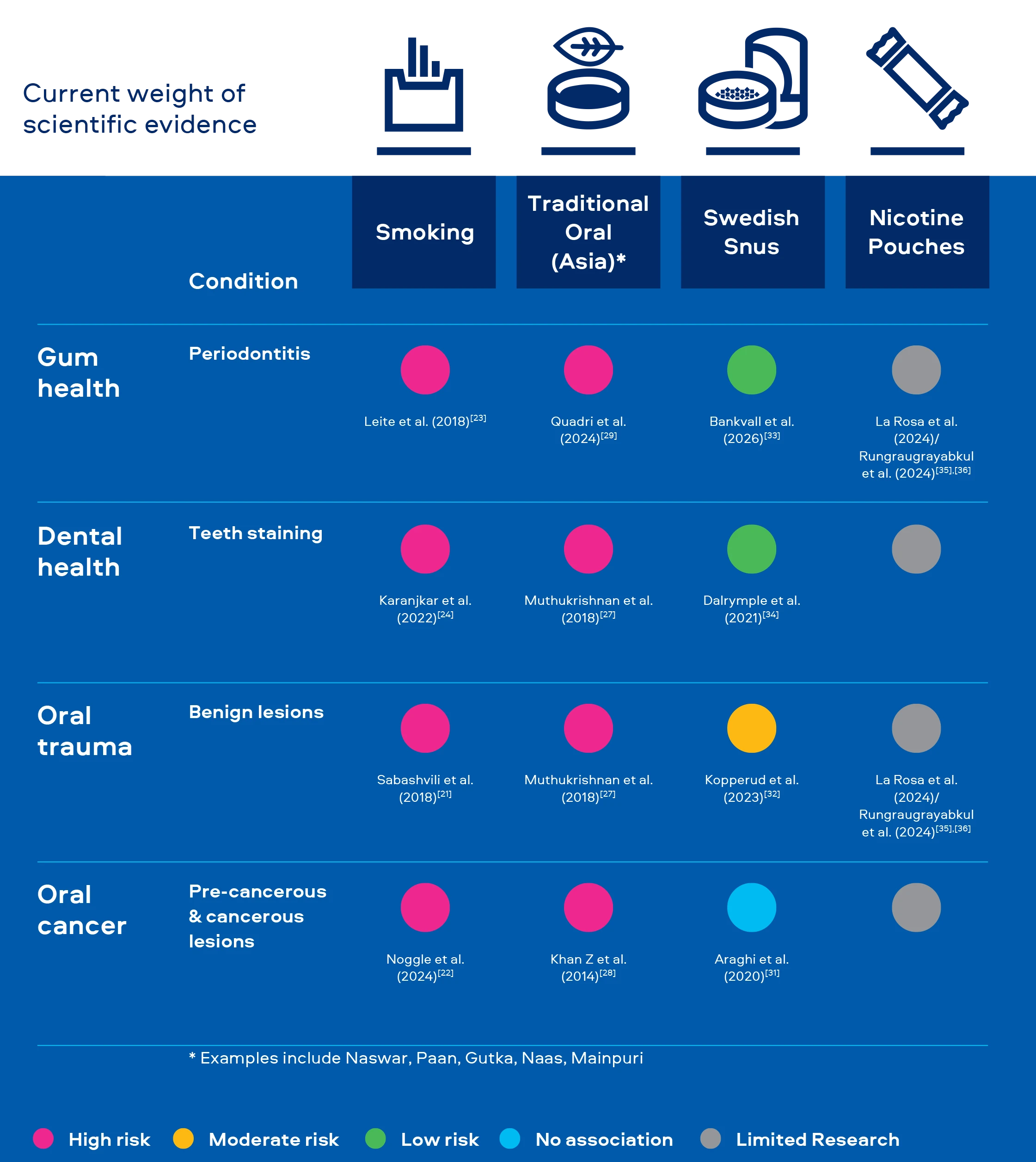
Unlike traditional oral tobacco products, the manufacturing process of Swedish snus involves pasteurisation, which removes and/or reduces the levels of many unwanted toxicants from the finished product[30]. Evidence from large prospective cohort studies and pooled analyses in Scandinavian populations have not demonstrated a consistent association between Swedish snus use and oral cancer when analyses are restricted to never-smokers[31]. Consequently, Swedish snus appears to present a much lower risk*† profile to combustible cigarettes and certain traditional oral products found in parts of Asia.
Although evidence indicates an association between daily snus use and localised oral mucosal changes, often described as “snus lesions”, these changes are generally considered benign and are typically reversible upon cessation or reduction in use[32]. Furthermore, despite evidence indicating an association with localised gingival recession, particularly at product placement sites, findings linking Swedish snus use to generalised periodontal disease are inconsistent, and current evidence does not support a clear association with destructive periodontitis[33]. Reported inflammatory changes are also typically limited in extent and appear to resolve after cessation. Similarly, tooth staining can occur with Swedish snus use but appears to be less pronounced than that associated with cigarette smoke and is largely reversible following cessation and professional dental care[34].
Whilst evidence relating to Oral Nicotine pouches remains limited, particularly with regard to long-term health outcomes, based on currently available toxicological and compositional data, it has been suggested that oral health risks of Oral Nicotine pouches may be comparable to or lower than those associated with Swedish snus[35]. Early evidence suggests that any effects on oral tissues are likely to be localised, reflecting product placement, and may include transient mucosal or gingival changes, similar to Swedish snus[36]. These effects appear to be reversible following cessation, although the current evidence base is limited. Furthermore, Oral Nicotine pouches have been shown to produce minimal tooth staining[34], likely as a result of the fact that they do not contain tobacco. To confirm these emerging evidence based conclusions, particularly with regard to the long term oral health impacts of Oral Nicotine pouches, well designed longitudinal human studies are required, an active area of ongoing research.
While the oral health impacts of combustible tobacco are well established, a growing body of evidence indicates a more differentiated risk spectrum among Smokeless Products. Overall, epidemiological data indicate that the oral health risks associated with Swedish snus are substantially lower than those associated with combustible tobacco. Observed effects for Swedish snus are predominantly localised to the placement site, reversible, and do not appear to be associated with long term health consequences. Based on their toxicological and compositional data, it is suggested that Oral Nicotine pouches will have a similar or lower oral health impact as Swedish snus. However, it is important to recognise that evidence gaps remain; well designed longitudinal human studies are required to confirm these initial hypotheses. As an organisation, we are actively seeking to further understand the impact of Oral Nicotine pouches on oral health.
Footnotes
^ Examples include Naswar, Paan, Gutka, Naas, Mainpuri
* Based on the weight of evidence and assuming a complete switch from cigarette smoking. These products are not risk free and are addictive.
† Products sold in the U.S., including Vuse, Velo, Grizzly, Kodiak, and Camel Snus, are subject to FDA regulation and no reduced risk claims will be made as to these products without agency clearance.
References
A full list of references for this page can be found in the section 11. References.

Exclusive access to the Omni™ Newsletter
Join the conversation shaping A Better Tomorrow™. Sign up to receive exclusive access to the Omni™ Newsletter and future Omni™ updates.
Signing up to the Omni™ Newsletter does not constitute consent to receive marketing communications.