
Big Question 3 - Why Is THR Important to BAT?

KEY SUMMARY POINTS
01
THR is central to our mission of reducing the health impact of our business.
02
There are ~110 million adult consumers of Smokeless Products#, with Vapour Products the largest contributor.
03
THR is a ‘win,win,win’ scenario for our stakeholders.
“A significant global shift is underway. The number of adult smokers switching to smokeless alternatives is growing, as is the body of evidence for supporting Tobacco Harm Reduction. When paired with informed, agile and responsive regulatory frameworks, the potential for real public health progress is enormous.”
Kingsley Wheaton
Chief Corporate Officer

THR is not only beneficial for public health, but it is also a business opportunity for BAT. We aim to avoid mistakes of the type that led to the fall of Blockbuster.
Blockbuster was the dominant player in the video rental industry. At its peak, late fees had become an important part of Blockbuster’s revenue model. Facing the up and coming rival Netflix, which had no late fees and was based on a subscription model instead, Blockbuster would have to alter its business model and sacrifice a key revenue stream to remain competitive. After the CEO finally recognised the threat, he embarked on changes, such as dropping late fees and creating a digital platform to compete. However, the board didn’t stick with the changes long term and they weren’t applied sustainably. After failing to adapt, five years later Blockbuster went bankrupt[1].
“Blockbuster’s story leaves us a clear lesson: adaptability is key to survival in a constantly changing market.”[1]
This case highlights the critical importance of long-term thinking in rapidly evolving industries. Failing to embrace necessary change in favour of short-term profit can lead even market leaders to collapse.
We recognised the emerging need for transformation and adapted our approach accordingly. Alongside evolving consumer preferences, we have diversified our portfolio to enable sustained, long-term growth.
A ‘win win win’ scenario
Since the seminal publication of the UK British Doctors’ Study on smoking and health in the 1950s identified major health risks of smoking[2], we have conducted extensive research into the issues related to smoking and health and developed technologies that could reduce the levels of harmful chemicals in cigarette smoke, in essence to develop a ‘safer cigarette’ and reduce the public health burden of smoking. We spent more than 40 years pursuing multiple avenues of research, including conducting R&D activities into developing and scientifically assessing a Reduced Toxicant Prototype (RTP) cigarette.
In our view an ideal business would:
- Offer reduced-risk*† and enjoyable tobacco and nicotine products to reduce the public health impact of smoking;
- Offer reduced-risk*† and enjoyable tobacco and nicotine products that adult smokers, who would otherwise continue to smoke, would choose to use; and
- Create a sustainable business based on lower risk*† products that are relevant to consumers and commercially viable.
While this ambition proved unachievable with respect to cigarettes, a ‘win, win, win’ scenario emerged with the advent of Vapour Products in the early 2010s, marking the beginning of a new chapter for BAT.
THR: Enabling the Transformation of BAT
Our belief is that there are three dimensions that are enabling the transformation of BAT through THR:
- Smokeless Products are increasingly being accepted as scientifically substantiated lower risk*† relative to cigarettes.
- Today, we have 34.1 million adult consumers# using our Smokeless Products on at least a weekly basis.
- Smokeless Products can ultimately create sustainable value for our shareholders.
Three commercial misconceptions about Smokeless Products:
- The number of consumers of Smokeless Products has stalled.
- Smokeless Products are not commercially sustainable.
- Smokeless Products make up a fraction of tobacco companies’ business.
The Number of Consumers of Smokeless Products is Increasing
We decided on a multi-category approach to Smokeless Products as adult consumers’ preferences vary across the globe, and no single product category would be sufficient to transition adult smokers, who would otherwise continue to smoke, away from smoking. We have observed growth in each category (Figure 1) as more and more adult smokers transition, with Vapour Products being the largest category globally, followed by Heated Products and then Oral Nicotine Pouches.
Smokeless Products Offer Commercial Sustainability
We are now in our second decade of our Smokeless Products business. In 2025, we exited with £3.63 billion revenue from our Smokeless Products business and had already become profitable (on a category contribution basis) two years ahead of guidance.
Smokeless Products Make Up an Increasing Share of Our Business
Aligned to our corporate ambition of having at least 50% of our revenue in Smokeless Products by 2035, we have 23 markets which are on their way to meeting this target (Figure 2).
While many key markets allow the sale of our full portfolio of Smokeless Products (Heated Products, Vapour Products, and Oral Nicotine Pouches), significant restrictions persist, with many markets limiting one or more products and some markets (e.g., India and Brazil), banning Smokeless Products altogether.
We will continue working with regulators and other stakeholders to facilitate the opening of these categories and markets. Open markets, underpinned by robust regulation and effective enforcement against noncompliant products and manufacturers, are key to creating A Better Tomorrow™ by Building a Smokeless World.
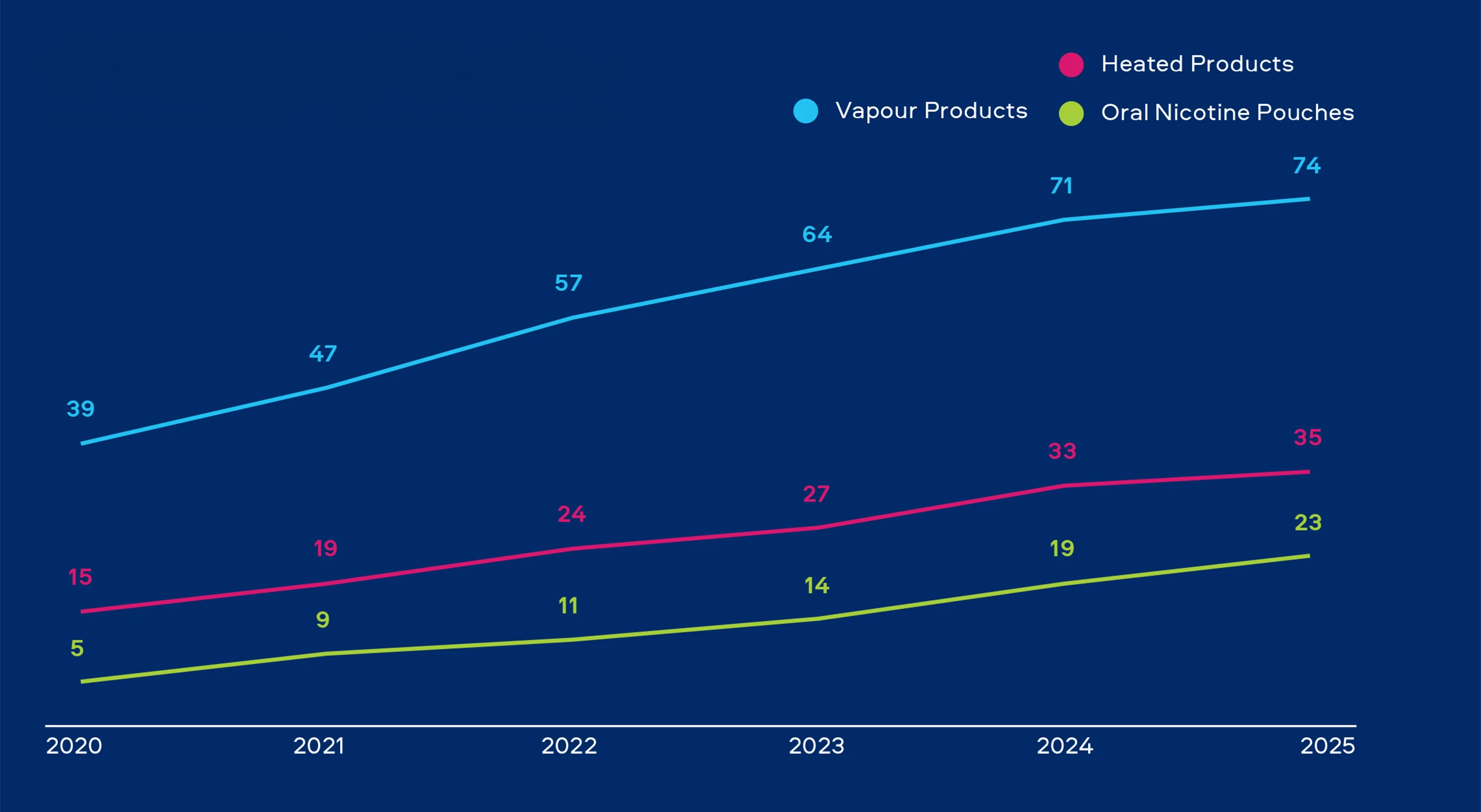
Figure 1. Longitudinal growth of Smokeless Products (Total adult consumers, millions#)
50m
Our corporate ambition is to have 50 million consumers# of our Smokeless Products by 2030
>55%
More than half of the total Smokeless Product consumers use Vapour Products
>30%

Denmark

Slovenia

Latvia
>40%

Italy

France

Czechia

Ireland

Lithuania

Portugal

Channel Islands
>50%

Japan

UK

Norway

Austria

Kazakhstan

Greece

Iceland

Estonia

Poland
>70%

Sweden

Finland

Slovakia

UAE
Figure 2. Global BAT markets which have Smokeless Product revenues^ greater than 30%
Footnotes
^ Revenue from Smokeless Products as a % of total revenue in each respective market as per 2025 full-year results.
* Based on the weight of evidence and assuming a complete switch from cigarette smoking. These products are not risk free and are addictive.
† Products sold in the U.S., including Vuse, Velo, Grizzly, Kodiak, and Camel Snus, are subject to FDA regulation and no reduced-risk claims will be made as to these products without agency clearance.
# Adult smokers are adult consumers who smoke daily. Adult smokeless product consumers are adult consumers who use any smokeless product category at least on a weekly basis. BAT smokeless product consumers are defined as adults who consume Vapour, Heating Products, Modern Oral pouches or Traditional Oral pouches at least on a weekly basis. For cross-manufacturer estimates, the smokeless products category excludes Traditional Oral pouches. For full definitions, please refer to the cautionary statement.
References
A full list of references for this page can be found in the section 11. References.
Exclusive access to the Omni™ Newsletter
Join the conversation shaping A Better Tomorrow™. Sign up to receive exclusive access to the Omni™ Newsletter and future Omni™ updates.
Signing up to the Omni™ Newsletter does not constitute consent to receive marketing communications.