

Our Scientific Framework

We first shared our framework approach ‘for the assessment of reduced-risk Tobacco and Nicotine products’ in 2015[3]. Over time, the presentation of our approach has evolved; however, the principles behind how our weight-of-evidence approach is used to assess our Smokeless Products have remained consistent.
We look to understand:
- How the product works;
- How the product may impact an individual;
- How the product may impact a population, and
- What the effect of time may be.
“For over a decade our scientific framework has guided how we assess Smokeless Products, and today it is underpinned by a substantial and continually expanding body of evidence, reflecting the depth and rigour of our scientific approach.”
Dr Mark Forster
Principal Scientist, Scientific Affairs
Our 9-Step Risk Assessment Framework
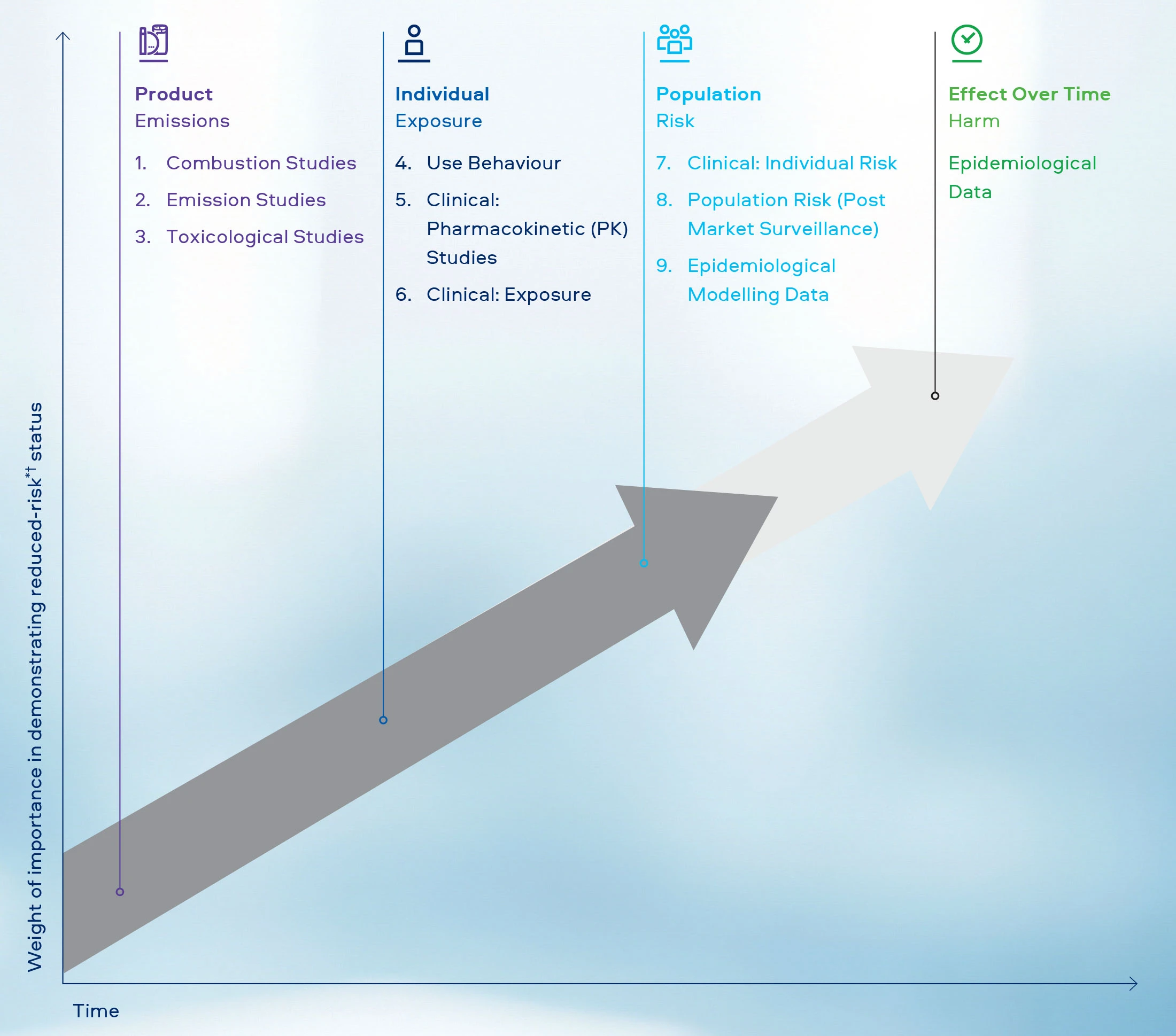

Product
When we consider how the product works, our focus is on its emissions and how these compare to cigarettes.
01 Combustion Studies
It is the combustion of tobacco in cigarettes that produces the thousands of chemicals in smoke[27]. We have established a series of analytical techniques to determine that there is no combustion in our Smokeless Products[28].
02 Emission Studies
In the absence of combustion, the aerosols of our Vapour and Heated Products are simpler, compared to cigarette smoke. We measure the levels of toxicants in these aerosols and compare them to those found in cigarette smoke, demonstrating significant reductions[9],[29].
Oral Nicotine Pouches do not form an aerosol. We measure the toxicant levels that can be extracted from these products and compare these levels to those found in cigarette smoke. With no combustion or tobacco, these products show the lowest levels of toxicants compared to cigarette smoke[30].
03 Toxicological Studies
With our Smokeless Products having simpler aerosols and extractions, and lower levels of toxicants, we then determine their impact on biological cells and tissues compared to cigarette smoke. Our toxicological assessments use a variety of standardised historical and contemporary cell or tissue-based test methods[31],[32]. These studies help determine that the aerosols and extractions of our Smokeless Products have reduced toxicity compared to cigarette smoke[33],[34],[35].

Individual
Once we have proven that a Smokeless Product can offer a smoker a reduction in toxicants and toxicity, we determine whether adult consumers may use the product in a way which negates these reductions.
04 Use Behaviour
We conduct behavioural studies with current adult smokers to understand how adult consumers use the product and how often they use it. This information helps assess consumers’ exposure to product emissions and informs the design of our laboratory and clinical studies, which aim to mimic actual usage patterns.
05 Clinical: Pharmacokinetic (PK) Studies
We conduct clinical studies to compare how nicotine from our Smokeless Products is absorbed and metabolised before, during, and after product use. We compare this data to historical cigarette data. This is important to demonstrate that our Smokeless Products can be satisfactory alternatives for adult smokers who would otherwise continue to smoke.
06 Clinical: Exposure
We conduct clinical studies to determine whether the reduction in toxicants in our Smokeless Products’ aerosols and extractions result in reductions in exposure for adult smokers who switch completely. Biomarkers that indicate product exposure to certain toxicants are measured in the user’s urine and bloodstream. We compare adult smokers who switch to Smokeless Products, with adult smokers who continue to smoke, and adult smokers who quit. Overall, all of our Smokeless Products showed significant reductions in exposure to toxicants by adult smokers who switched completely[36],[37],[38].

Population
Once we have proven that individuals will use our products in a manner that does not offset the described toxicant reductions, we look to determine what the long term and population effects could be.
07 Clinical: Individual Risk
We conduct longer-term clinical studies of at least three months duration. We evaluate changes in biomarkers of potential harm (BoPH). These BoPH are associated with the potential development of smoking-related diseases. Overall, all of our Smokeless Products showed favourable changes in these biomarkers by adult smokers who switched completely[36],[37],[38].
08 Population Risk
(Post Market Surveillance)
We monitor the self-reported consumption behaviour of a population over time to understand potential effects relevant to Tobacco Harm Reduction (THR). Evidence from studies of selected Smokeless Products indicates that average daily consumption is comparable to, or lower than, cigarette consumption rates[39].
09 Epidemiological Modelling Data
We have developed and validated a modelling tool to assess a wide range of scenarios that consider potential benefits and harms from changes in tobacco and nicotine product use patterns[40],[41]. We can model if there is a potential survival benefit in smoker groups who completely switch to Smokeless Products. We can model this data against the risk of never- and former-adult smokers adopting the new product. These types of studies evaluate population health risks and predict how these risks may change over time.

Effect Over Time
We know it is not possible to accelerate time; however, understanding the long-term effects of using Smokeless Products is important. We are constantly assessing how we can leverage available real-world evidence and data from adult smokers, who have switched to Smokeless Products, long term.
Long-term epidemiological data exists for traditional Oral Tobacco Products (snus) that demonstrate its THR potential[42],[43]. Through our risk assessment framework, we have demonstrated that Oral Nicotine Pouches have reductions in toxicants, toxicity and exposure comparable and lower than snus, which would support the bridging of snus epidemiological data to the Oral Nicotine Pouch category[30].
A Weight of Evidence for Tobacco Harm Reduction
Our risk assessment framework enables us to deliver a body of evidence that validates the reductions in toxicants, toxicity, and exposure for our Smokeless Products when compared to cigarettes. We believe this evidence should increase acceptance of THR principles by regulators which can help encourage adult smokers, who would otherwise continue to smoke, to switch to smokeless alternatives.
Footnotes
* Based on the weight of evidence and assuming a complete switch from cigarette smoking. These products are not risk free and are addictive.
† Our products as sold in the U.S., including Vuse, Velo, Grizzly, Kodiak, and Camel Snus, are subject to FDA regulation and no reduced-risk claims will be made as to these products without agency clearance.
References
A full list of references for this page can be found in the section 11. References.
Exclusive access to the Omni™ Newsletter
Join the conversation shaping A Better Tomorrow™. Sign up to receive exclusive access to the Omni™ Newsletter and future Omni™ updates.
Signing up to the Omni™ Newsletter does not constitute consent to receive marketing communications.