
Population Risk and Modelling

Lab- and clinic-based science allows us to better understand the lower risk*† profile of our Smokeless Products compared to cigarettes. With population models, we can generate insights into the potential health impact our products may have on the population when they are introduced to a market.
The introduction of a new product to a market can be associated with varying product usage behaviours among adult consumers, leading to both positive and negative health effects. These behaviours need to be evaluated in totality to understand the population level health impact.
When a new Smokeless Product is introduced to the market, long-term observational data on use behaviour and health impact are not yet necessarily available. In the absence of these data, a need still exists to understand the potential population health impact. Computational models, which are commonly used in the fields of statistics, economics, and demography, can be developed and used to investigate the potential effect of new Smokeless Product introductions on consumer behaviour and population health.
Population Health Impact Models
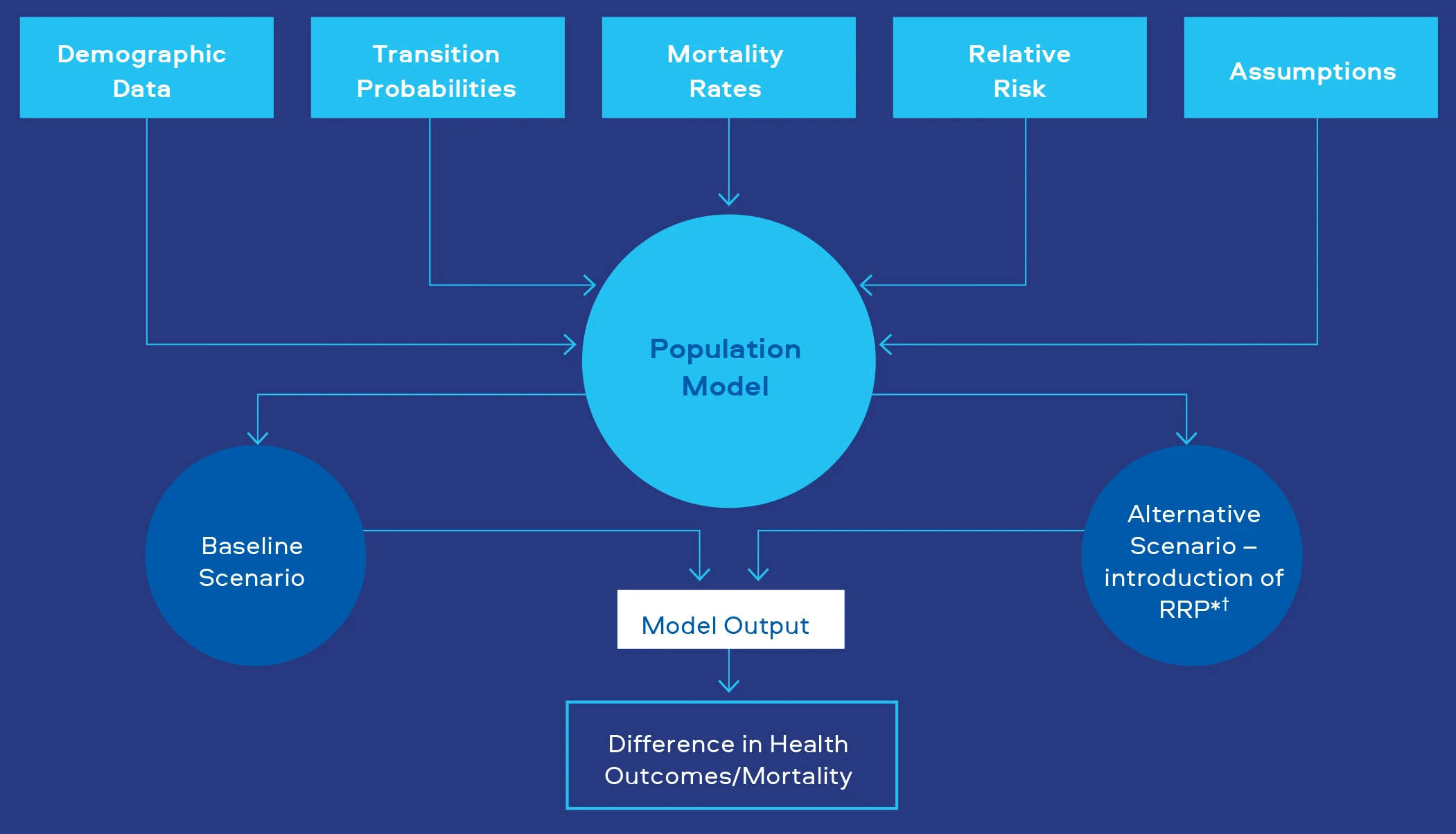
Computational models enable the projection of population-level effects by assessing the potential for specific outcomes. These models use mathematical methodologies to simulate the potential effects of different exposure and risk scenarios within a specified population, allowing the input of data such as product use behaviour transition probabilities (e.g., initiation, quitting, switching) and a risk estimate dependent on product use status. Customarily, such models use publicly available demographic data and published studies to inform model input parameters. Where data are not available, informed assumptions and consensus estimates can be used. The outputs of population models are often evaluated comparatively, calculating the potential health outcome of the base case scenario (e.g., cigarettes only) and comparing it to a scenario where a Smokeless Product has been introduced to a market. This comparison enables the calculation of the difference in health outcomes/mortality (Figure 1).
Figure 1. Example schematic of model input and output data and assumptions
“Population modelling estimates the public health impact of Smokeless Products across markets, particularly where epidemiological evidence is limited, by integrating data on product use behaviours and health outcomes.”
Jagpreet Singh
Head of Digital and Data Sciences
Prospective Modelling: Predicting The Population-Level Effect of Smokeless Products
Over the past decade, various mathematical models have been used to evaluate the potential public health impact of switching smokers to Smokeless Products. The results of these evaluations support the proposition that such products have the potential to reduce the prevalence of smoking and the related death toll across the globe.
A vaping model study by Levy et al. evaluated the potential impact on public health of relaxing restrictions on Vapour Products in Australia, predicting that as many as 100,000 deaths could be averted during the period 2017-2080, if Australia were to embrace Tobacco Harm Reduction by increasing access to these products[108]. This finding aligns with similar studies on Smokeless Products’ potential to reduce smoking prevalence in Germany[109] and Russia[110].
Retrospective Modelling: Applying the Swedish Experience Across the EU
An example of retrospective modelling is the analysis performed by a group of physicians and academics regarding the population health impact of the Oral Tobacco Product, snus[111]. At the time of the analysis in 2017, the total tobacco consumption level in Sweden was similar to that of other European Union (EU) countries, but Sweden consistently had much lower smoking prevalence, the reduction of which occurred alongside a rise in the use of snus. However, snus products have been banned in the European Union, aside from Sweden, since 1992[112].
Utilising data from the World Health Organization[113], which calculated the tobacco-related mortality rate of each of the relevant countries as well as the prevalence of smoking, the researchers extrapolated the impact of introducing snus in the other European countries. The resulting report predicted that had other EU Member States adopted Sweden’s tobacco consumption patterns, more than 2.89 million potential deaths could have been averted over a 20-year period (Table 1)[111].
Table 1. Retrospective Population Modelling: Apply Sweden's Tobacco-Attributed Mortality and Morbidity, 2000-2019[111]
Country
Lives Saved

Denmark
116,000

Netherlands
125,000

Italy
125,000

France
91,000

Germany
454,000

UK
680,000

Spain
31,000

Poland
442,000

Romania
251,000

Greece
170,000

Bulgaria
249,000

Hungary
251,000

EU
2.89 million
References
A full list of references for this page can be found in the section 11. References.

Exclusive access to the Omni™ Newsletter
Join the conversation shaping A Better Tomorrow™. Sign up to receive exclusive access to the Omni™ Newsletter and future Omni™ updates.
Signing up to the Omni™ Newsletter does not constitute consent to receive marketing communications.