

Our Future Ambitions

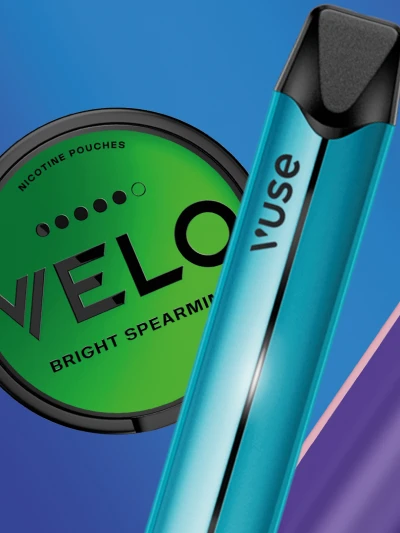
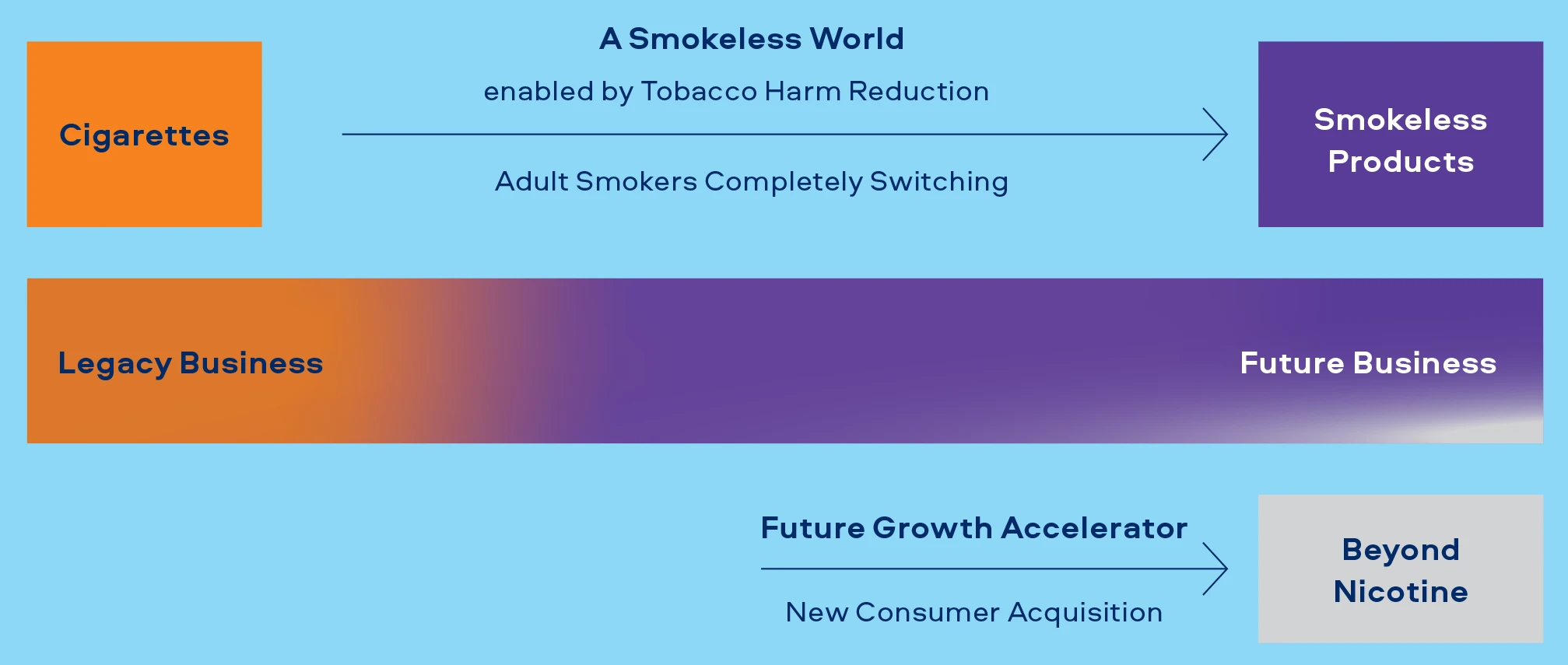
As we enter the second decade of our transformation, we have re-articulated our ambitious plans to create A Better Tomorrow™ through Building a Smokeless World. Our aim is to become a high-growth, global consumer goods company: consumer-centric, multi-category, with sustainability at our core. We believe A Better Tomorrow™ will be enabled by our lower risk*† profile, Smokeless Products that deliver public health benefits via Tobacco Harm Reduction (THR), and our parallel strategy to explore opportunities beyond nicotine.
Tobacco Harm Reduction
As we move forward, we want to continue to build momentum. We have clear internal goals, as well as five global stakeholder needs, that are essential to successfully delivering our ambition:
Internal goals
- Continue the research to support the THR potential of our Smokeless Products
- Set new expectations for relationships with regulators, public health, and scientific stakeholders
- Continue to publish our studies in peer reviewed scientific journals
- Creation of internal global guidelines that advance THR by restricting underage access and usage of Smokeless Products
Global stakeholder needs
- A global regulatory framework that supports both tobacco control and THR as part of their public health strategy on tobacco and nicotine
- Accurate communication from public health and regulatory authorities on the risk profile of Smokeless Products relative to smoking
- Accurate communication from public health and regulatory authorities on the risk profile of nicotine
- All markets around the world make Smokeless Products available
- A global regulatory framework that is aligned with the pace of innovation in Smokeless Products
Progress has been evident from the first decade of our transformation, in terms of transitioning a significant portion of our legacy cigarette business to our Smokeless Products business. Today, Smokeless Products account for more than 18% of our total revenues. This part of our business became profitable in 2023, two years ahead of schedule. Additionally, in 23 of our 78 global Smokeless Products markets, >30% of the total revenues in those markets are from Smokeless Products, demonstrating the THR penetration within those markets.
Our Smokeless Products’ contribution to global THR is significant. We have the second largest number of Smokeless Product adult consumers, demonstrating that our multicategory portfolio approach is actively encouraging adult smokers, who would otherwise continue to smoke, to switch.
Our decade of transformation:
34.1m
adult consumers of our Smokeless Products#
18.2%
of total revenues of BAT accounts for Smokeless Products
78
markets in which our Smokeless Products are available
Beyond Nicotine
Apart from our Tobacco Harm Reduction strategy, our future growth accelerator, Beyond Nicotine, was launched in 2021. With Beyond Nicotine we aspire to build a pathway to a new portfolio of non-nicotine-based products that can enhance BAT’s future growth. We have clear internal goals but also global stakeholder needs that are essential to our ambition:
Internal goals
- Create a second engine of innovation in Beyond Nicotine
- Grow a global science and innovation ecosystem that enables the creation of a consumer-inspired product portfolio
- Utilisation of a science programme to understand critical principles of product quality and efficacy of our new Beyond Nicotine innovations
Our Beyond Nicotine growth accelerator is key to our transformation to become a high-growth, global consumer goods company. We aim to provide even more choice in new and exciting areas of product innovation and meet the evolving needs of adult consumers, through exploring opportunities beyond nicotine, such as ‘Wellbeing & Stimulation’.
Our global functional wellbeing brand ‘Ryde:’ focuses on ‘making wellbeing feel easy’ through delicious and efficacious consumer products.
This range of functional products are designed to be used by adult consumers to support them through various moments of their day and includes products to help boost energy and improve focus, as well as others that aid relaxation and sleep.
Crucially, all our Ryde: products are science-backed. Ryplenish™ refers to the end-to-end process that has underpinned the development of each of our shots. This includes the inclusion of a scientifically-backed formula of ingredients, so that they support the right effects based on the respective front-of-pack product description (e.g. Energize, Focus, Relax, Sleep). To further demonstrate our commitment to the credibility of our products, our science team are also actively publishing research in reputable peer-reviewed scientific journals that specialise in health and nutrition[14],[15].
Pilot tests suggests that there is significant commercial and consumer interest and opportunities for Ryde, which has led to the national expansion of the brand. We are in the initial phases of our Beyond Nicotine journey and are making significant investments in a global science and innovation ecosystem. This will enable us to leverage our strengths, as well as to develop new ones, in order to better meet the needs of the consumers of tomorrow.
A representation of our vision to create A Better Tomorrow™ through Building a Smokeless World and our parallel strategy to explore opportunities beyond nicotine.
A Better Tomorrow™
My Personal Reflection on Science, Transformation, and The Future
By Dr James Murphy, Director of Research & Science BAT
Dear Reader,
There are moments in history when the direction of travel for public health can be shaped for generations. I believe tobacco and nicotine policy is now at one of those defining moments.
For decades, BAT was a business that sold only cigarettes. That history is part of the sector we come from, and it is precisely why the transformation now underway matters. If our ambition is to build A Better Tomorrow™ and accelerate progress towards a smokeless world, success cannot be measured only by what we sell. It must also be measured by what we replace, the choices we create for adult smokers, and the impact those choices have on reducing harm.
The health risks of smoking are well established. The question is whether tobacco control should continue to rely primarily on prevention and cessation, or whether Tobacco Harm Reduction should also be embedded as a core tenet of public health strategy on tobacco and nicotine. I believe the potential benefit of doing so is profound. Prevention and cessation must remain central, but adults who would otherwise continue smoking should not be left with cigarettes as their only option.
Sweden provides a compelling proof of principle for Tobacco Harm Reduction. It shows what can happen when adult consumers have access to acceptable smokeless alternatives and smoking is displaced at population level. The Swedish experience should not be treated as a simple template for every country, but it should be taken seriously as evidence that policy can influence the speed and scale of movement away from cigarettes. Other countries are also contributing important evidence. In the USA, the UK, Japan and New Zealand, different forms of smokeless or lower-risk*† profile nicotine products have been adopted within different regulatory and cultural contexts. These examples are not identical, and they should not be overstated, but collectively they reinforce an important point: when adult smokers have access to alternatives that are acceptable, appropriately regulated and supported by evidence, movement away from cigarettes can accelerate.
At this point in the history of tobacco and nicotine policy, society faces two broad pathways. One pathway maintains the status quo: banning, restricting or discouraging smokeless alternatives, despite their potential as substitutes for adult smokers who would otherwise continue smoking.
“Our invitation remains unchanged: Come and see the science for yourself. Meet the scientists. Examine the technologies. Ask difficult questions. Challenge the evidence. Join the conversation.”
Dr James Murphy
Director, Research & Science

The other pathway embeds Tobacco Harm Reduction within public health strategy, permitting responsible access to scientifically substantiated smokeless alternatives alongside prevention, cessation, youth protection and robust regulation. This is not a call to weaken tobacco control. It is a call to make it more complete.
As a scientist by training and a business leader by responsibility, I have always held a simple principle: science should be judged on its quality, transparency, reproducibility and scientific merit, not on who funded it. At BAT, we place only highly stewarded, rigorously assessed and quality-controlled products on the market. We welcome challenge because challenge strengthens science. But public health does not advance when evidence is dismissed before it is examined. Science progresses through scrutiny, discussion, replication and transparency, not exclusion. Transparency is more than a commitment; it is a principle. For over two decades, we have welcomed scientists, regulators, public health experts and other stakeholders to our Southampton campus to engage directly with our science and the evidence underpinning Tobacco Harm Reduction.
Our invitation remains unchanged: “Come and see the science for yourself. Meet the scientists. Examine the technologies. Ask difficult questions. Challenge the evidence. Join the conversation.”
You do not need to agree with us. But meaningful progress begins with open dialogue and a shared willingness to follow the evidence wherever it leads.
We are at a pivotal moment in public health. Our responsibility is clear: follow the evidence, embrace challenge, and focus relentlessly on what matters most: Reducing the harm caused by smoking.
That, to me, is what truly matters.
Dr James Murphy
My Personal Reflection on A Smokeless World
By Kingsley Wheaton, Chief Corporate Officer
Dear Reader,
My colleague, Dr James Murphy, ends his reflections precisely where I would like to start.
“You do not have to agree with us. But meaningful progress begins with open dialogue.”
And that was always the Omni™ invitation. Review the evidence. Join the conversation. A conversation where we would be wise to first recognise where we agree, and then set about resolving and finding common ground on those areas where we may disagree.
Sadly, that is not going to be well served by the exclusionary tactics of those that disagree with us. Time and again, James and myself – and countless others – have made the offer for transparent and open dialogue to those who may not always share our opinion. That is how society brokers disagreement into eventual agreement. It is for millennia how the wise and the pragmatic have solved knotty problems. This challenge should be no different.
So, what if the world is not ‘wise and pragmatic’? Where does that leave us? Some may argue the opposite of ‘pragmatic’ is ‘dogmatic’ and indeed one can see examples of where ideology and dogma have been allowed to trump the ever-growing evidence base.
Article 5.3 (of the World Health Organization Framework Convention on Tobacco Control) is too often interpreted in ways that discourage scientific dialogue and consideration of evidence, even where that evidence may be relevant to public health decision-making.
Omni™ has come a long way in two years and it is with some pride that we release a major upgrade and launch Omni™ 2.0.
We have listened to feedback, taken account of alternative views and attempted, as far as we are able, to update Omni™ to answer those questions that have emerged, or developed, since the initial launch in September 2024.
In some ways, it is easier to define what Omni™ is not than what it is. It is not a book, a publication or website. Although it can be all of those things.
For us, it is a manifesto and a mandate. A manifesto for change and a mandate for action. As we grapple with the challenges of becoming a predominantly smokeless business by 2035, Omni™ is our scientific and regulatory engagement North Star. A star that guides us and allows us to focus our stakeholder engagement energy, both where it matters and, with content that matters.
One wonders where this dialogue will be by the time of Omni™ 3.0 in years to come? Time will tell. One can only hope that the step-forward that is Omni™ 2.0 will have made a difference.
The weight of evidence for Tobacco Harm Reduction is indeed mounting. The question for regulators and policy makers is can they afford to wait? To chart a course of precaution, to naively lump all nicotine products together – ignoring whether or not there is combustion – and await the likely decades-from-now epidemiology, sacrificing potentially meaningful public health progress for hesitation and inertia?
“Meaningful progress starts with open dialogue. We continue to stand ready to have that dialogue with policy makers, regulators, investors and scientists anywhere, at any time.”
Kingsley Wheaton
Chief Corporate Officer

Europe is a case in point. The debate surrounding the revision of tobacco and nicotine policy across the 27 member states, including the Tobacco Products Directive, is intensifying – and the mood music is not encouraging.
By 2040, the EU set itself a target to reduce smoking prevalence rates to 5% from today’s average of 24%. However, since the current Tobacco Products Directive was introduced in 2016 there has only been a ~2% reduction[16],[17]. If it’s serious about this objective, something needs to change.
Thankfully, it doesn’t need to look too far. Sweden is well on track to becoming smokefree and provides a real-world example that the rest of Europe can and should follow. In a political union such as Europe, you would want to study the best-in-class, make sure those solutions ‘travel’ and implement with speed with a concept that has demonstrated, more than anything else, that it simply works.
So, our hope, indeed my hope, is that Omni™ 2.0 contributes in some small way to productive discussions. Discussions where evidence is reviewed, the findings followed, and pragmatism and common-sense are encouraged to prevail. That is the pathway to a Smokefree Europe in 2040 and the answers to that conundrum, paradoxically, already exist within Europe’s borders.
As I reflect on 30 years in the tobacco and nicotine industry I have never been more excited, and yet, frustrated at the same time.
Excited because we are building pace and making big strides towards our ambition to Build A Smokeless World. Frustrated because, despite the science and real-world experiences, progress is often slowed by longstanding perceptions and deeply entrenched positions that are increasingly difficult to reconcile with emerging evidence.
Reasonable people can review the same body of evidence and reach different conclusions. The challenge is not that disagreement exists. The challenge is ensuring that disagreement remains rooted in evidence, and that new evidence is assessed openly as it emerges. And beyond that, ideally, that good-faith, open-minded dialogue ensues.
My wish then is that the clarion call of Omni™ be heeded. Review the evidence, join the conversation. As James reflected, meaningful progress starts with open dialogue. We continue to stand ready to have that dialogue with policy makers, regulators, investors and scientists anywhere, at any time.
That is the promise of Omni™.
Kingsley Wheaton
Chief Corporate Officer
Footnotes
* Based on the weight of evidence and assuming a complete switch from cigarette smoking. These products are not risk free and are addictive.
† Products sold in the U.S., including Vuse, Velo, Grizzly, Kodiak, and Camel Snus, are subject to FDA regulation and no reduced-risk claims will be made as to these products without agency clearance.
# Adult smokers are adult consumers who smoke daily. Adult smokeless product consumers are adult consumers who use any smokeless product category at least on a weekly basis. BAT smokeless product consumers are defined as adults who consume Vapour, Heating Products, Modern Oral pouches or Traditional Oral pouches at least on a weekly basis. For cross-manufacturer estimates, the smokeless products category excludes Traditional Oral pouches. For full definitions, please refer to the cautionary statement.
References
A full list of references for this page can be found in the section 11. References.
Exclusive access to the Omni™ Newsletter
Join the conversation shaping A Better Tomorrow™. Sign up to receive exclusive access to the Omni™ Newsletter and future Omni™ updates.
Signing up to the Omni™ Newsletter does not constitute consent to receive marketing communications.