
Big Question 1 - What is Tobacco Harm Reduction and What are the Desired Outcomes?

KEY SUMMARY POINTS
01
Tobacco Harm Reduction (THR) is a public health policy first described by the U.S. Institute of Medicine (now NASEM) in 2001.
02
THR occurs when adult smokers, who would otherwise continue to smoke, switch completely from cigarettes to reduced-risk*† tobacco and nicotine products.
03
Sweden is evidence of THR in action, with the lowest prevalence of adult smoking and the lowest rates of lung, tracheal, and bronchus cancer mortality in Europe, driven by a higher uptake of reduced-risk*† tobacco and nicotine products.
04
Alongside conventional measures, a wider adoption of THR can have significant public health impact.
“Tobacco Harm Reduction refers to minimizing harms and decreasing total morbidity and mortality, without completely eliminating tobacco and nicotine use.”
U.S. Institute of Medicine (2001)[1]
Harm reduction, in general, refers to health policies, strategies and programmes that aim to reduce the harms and negative impacts (social and/or physical) associated with what are deemed ‘risky’ behaviours; such approaches are not unique to tobacco smoking and are broadly employed and accepted across a wide range of contexts.
These approaches are grounded in improving individual and population health, supported by a robust evidence base demonstrating that the interventions are reduced-risk*†, practical, and effective across economic, social, and cultural contexts.
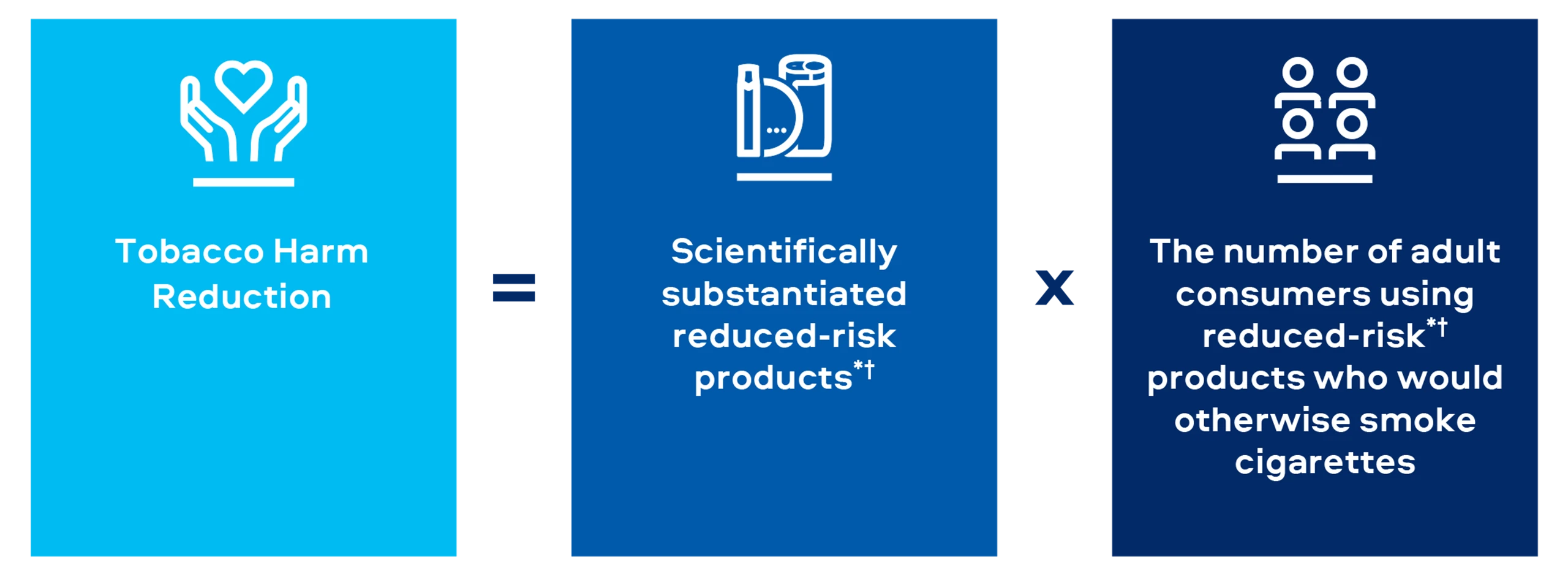
Tobacco Harm Reduction (THR) is based on the principle of decreasing total smoking-related harm by enabling adult smokers, who would otherwise continue to smoke, to switch completely to alternative forms of tobacco and nicotine products that have a lower risk*† profile compared to combustible cigarettes (Figure 1)[2]. It recognises that whilst nicotine is addictive, it is not the primary cause of smoking-related disease; the majority of the harm from cigarette use stems from the combustion of tobacco, generating toxicants that are subsequently inhaled[3],[4].
Figure 1. Tobacco Harm Reduction Equation
Historical Context
THR is not a novel concept. 25 years ago, in 2001, the U.S. Institute of Medicine (IoM) (now the National Academies of Science, Engineering, and Medicine (NASEM)) authored the publication Clearing the Smoke which further outlined the principles of THR, defining the concept as “decreasing total morbidity and mortality, without completely eliminating tobacco and nicotine use”[1]. Today, it is widely acknowledged that the majority of serious health risks associated with cigarette smoking arise from inhalation of toxicants produced during combustion and not from nicotine itself[3],[4]; decades of scientific assessment have since enabled the placement of non-combustible reduced-risk*† products (Smokeless Products) on a continuum of risk. Globally, there are four categories of Smokeless Products; Heated Products, Vapour Products, Oral Tobacco Products and Oral Nicotine Pouches.
“Embracing harm reduction alongside conventional measures could roughly double the lives saved compared to current policies alone … preventing over 3 million deaths a year globally.”
Yach and Human 2025[5]
THR in Action – Updated Evidence of Impact:
There is growing consensus among many members of the public health community and academics about the role of Smokeless Products as reduced-risk*† alternatives to smoking.
1. Oral Nicotine Pouches: Extensive epidemiological evidence from Sweden shows that snus use, a form of Oral Tobacco Product, is associated with substantially lower risks than cigarette smoking[11],[12]. This is reflected in the US FDA’s 2019 determination that completely switching from cigarettes to certain types of Swedish snus can reduce the risk of several major smoking-related diseases[13]. Emerging evidence indicates that Oral Nicotine Pouches contain even fewer and lower levels of toxicants than snus and demonstrate reduced toxicological impact[14], suggesting the potential for further risk reduction and highlighting the likelihood that Oral Nicotine products can be expected to present lower risk*† than continued cigarette smoking.
Sweden provides the leading example for the effectiveness of THR.
Its long-standing regulatory and consumer acceptance of smokeless alternatives has coincided with a sustained decline in cigarette smoking over several decades. As a result, Sweden has the lowest smoking prevalence in Europe (5.4% in 2024)[11] and the lowest mortality rates for cancers of the lung, trachea and bronchus in the EU[12].
2. Vapour Products: Vapour Products remain the largest smokeless category globally, with an estimated 74 million current adult users worldwide#. In 2015, Public Health England (PHE) released a landmark evidence review which estimated that responsibly manufactured and appropriately stewarded e-cigarettes are around 95% less harmful to health than conventional cigarettes[6]. This conclusion has since been cited and refined through subsequent independent evaluations and supported by organisations such as the Office for Health Improvement and Disparities (OHID), the Royal College of Physicians (RCP), the National Institute for Health and Care Excellence (NICE), and the Medicines and Healthcare products Regulatory Agency (MHRA)[7],[8],[9]. In the most recent review published by the OHID, it concluded: “Based on the reviewed evidence, we believe that the ‘at least 95% less harmful’ estimate remains broadly accurate… However, it might now be more appropriate and unifying to summarise our findings using our other firm statement: that vaping poses only a small fraction of the risks of smoking[7].”
In the United Kingdom, for example, the prevalence of Vapour Product use surpassed that of cigarette smoking for the first time in 2026[10].
3. Heated Products: By heating tobacco or other substrates rather than burning, Heated Products have the potential to be reduced-risk*† compared to smoking. Although the current evidence base includes research conducted by the industry, an increasing number of independent reports are broadly aligned with the conclusions and support the findings that switching to Heated Products is a reduced-risk*† alternative to smoking combustible cigarettes. Research commissioned as early as 2017 by the UK Department of Health found that people using Heated Products were exposed to around 50-90% less of the “harmful and potentially harmful” compounds compared with people smoking conventional cigarettes[15].
In Japan, cigarette smoking prevalence continues to decline, while use of Heated Products continues to rise; they hold 46% share of the total tobacco product market in the country[16]. Academic researchers in Tokyo have identified early epidemiological signals that point towards reduced acute coronary syndrome hospitalisations associated with the prevalence of Heated Product use (Figure 1)[17].
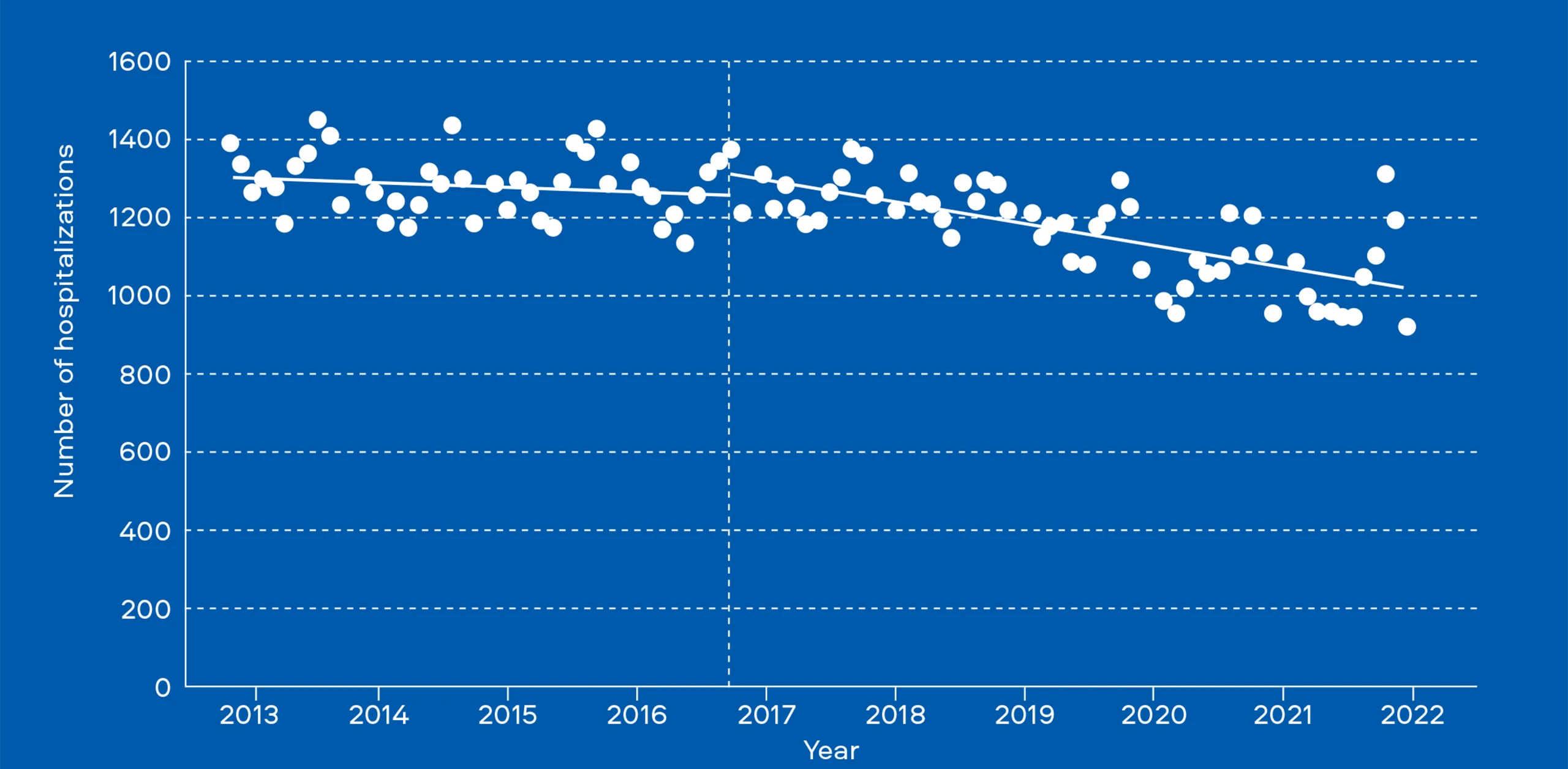
Figure 1. Changes of Acute Coronary Syndrome hospitalisations associated with the spread of Heated Product use (hospitalisations of patients who smoked)[17].
We are aligned with many of the goals of governmental public health strategies to lower global smoking prevalence rates. The World Health Organization (WHO) considers countries to be “smoke free” when smoking prevalence is less than 5% of the population[18].
Our Role in THR and Our Desired Outcomes
Our vision for success in Tobacco Harm Reduction (THR) is to create A Better Tomorrow™ by Building a Smokeless World. This world is one in which people, who would otherwise continue to smoke, can use forms of tobacco and nicotine that are less risky*† than cigarettes and, as an extension, society realises a substantial reduction in projected population level smoking-related harm. Despite the interventions of tobacco control, and the availability of smoking cessation pharmacotherapies for several decades, the WHO report that there are still in excess of 1 billion smokers globally[19]. Traditional tobacco control measures to date have not been sufficient in achieving smoke free status globally. Accelerated THR adoption is required to bridge this gap.
Advancing THR will depend on achieving a number of critical milestones that collectively support its credibility, acceptance, and implementation. These outcomes are central to enabling a transition toward a Smokeless World and ensuring that adult smokers, who would otherwise continue to smoke, have access to scientifically substantiated smokeless alternatives.
We Seek Three Main THR Outcomes:
01
Clear evidence of Smokeless Products’ role in harm reduction is verified and accepted
02
THR is accepted by regulators worldwide as a legitimate public health policy
03
Regulation of Smokeless Products, which is anchored in THR, is adopted globally
To achieve these outcomes, our role is to develop and responsibly market best-in-class, innovative products that support THR, underpinned by world-class science that clearly demonstrates the reduced-risk*† potential of Smokeless Products. Building on this evidence base, we aim to support the increased recognition of THR as a legitimate public health approach through transparent engagement and knowledge sharing. This includes contributing to the scientific and public health dialogue to improve understanding. Finally, we engage proactively with regulators and policymakers to support the development and adoption of regulatory frameworks for Smokeless Products that are anchored in THR.
Two Sides of the Discussion
THR has been the subject of a significant public discussion for the last two decades, with proponents stating its potential for a positive public health impact, with some of the most prominent public health and regulatory authorities (including the FDA, NHS, Royal College of Physicians and Public Health England) concluding that Smokeless Products have a lower risk*† profile than smoking[6],[8],[10],[20].
We strongly support open scientific discourse and objective, good faith discussion, which are essential to advance scientific understanding and public health policy. At the same time, we believe it is important that discussions around nicotine and Smokeless Products are informed by a comprehensive and rigorous evaluation of the available scientific evidence. However, in some markets, discussions informing Smokeless Product policy reflect a lack of convergence across evidence and perspectives, with limited intersection between differing interpretations. This highlights the importance of balanced, comprehensive, and methodologically robust evaluation to support aligned and evidence-informed decision-making.
The Future
THR holds the promise of profound public health benefits; epidemiological evidence from Sweden is robust proof of the possible future. We are observing increasing divergence in regulatory approaches to Smokeless Products across different markets that will fundamentally shape the future public health of the respective countries. A recent analysis indicates that, alongside established tobacco control measures, wider global adoption of THR strategies could contribute to the prevention of approximately three million premature deaths annually[5].
We believe that our THR ambitions are bold but achievable. We currently have 34.1 million adult consumers# using our Smokeless Products on at least a weekly basis, and by 2030 we aspire to have >50 million. By 2035, we aim to have at least 50% of our revenues in Smokeless Products. This continuously evolving landscape will require not just changes in consumer behaviour but also societal changes, particularly in terms of the policies of national and international regulatory and public health bodies.
If we can change the conversation around THR and Smokeless Products, we can change the future.
Footnotes
* Based on the weight of evidence and assuming a complete switch from cigarette smoking. These products are not risk free and are addictive.
† Products sold in the U.S., including Vuse, Velo, Grizzly, Kodiak, and Camel Snus, are subject to FDA regulation and no reduced-risk claims will be made as to these products without agency clearance.
# Adult smokers are adult consumers who smoke daily. Adult smokeless product consumers are adult consumers who use any smokeless product category at least on a weekly basis. BAT smokeless product consumers are defined as adults who consume Vapour, Heating Products, Modern Oral pouches or Traditional Oral pouches at least on a weekly basis. For cross-manufacturer estimates, the smokeless products category excludes Traditional Oral pouches. For full definitions, please refer to the cautionary statement.
References
A full list of references for this page can be found in the section 11. References.
Exclusive access to the Omni™ Newsletter
Join the conversation shaping A Better Tomorrow™. Sign up to receive exclusive access to the Omni™ Newsletter and future Omni™ updates.
Signing up to the Omni™ Newsletter does not constitute consent to receive marketing communications.